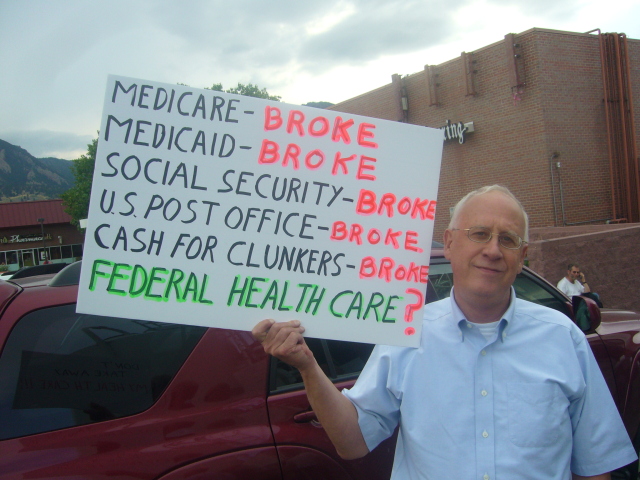
Wednesday, August 26, 2009

That would be in CANADA .....

If anyone is having a contest for the silliest argument for ObamaCare, we'd like to nominate yesterday's USA Today op-ed by Patricia Pearson, a Canadian member of the paper's board of contributors. It's titled "The Truth About Canadian Health Care." The subtitle reads: "I've been treated in the American system and have lived with universal care in Canada. Guess which one is freer--and more humane."

If you guessed that this is a brief for Canada's government health-insurance monopoly, you're right! But wait. Here is her U.S. health-care "horror story":

The only time in my life that I have ever had to plead my case for health treatment to a bureaucrat was when I lived in New York City.

I had purchased out-of-country medical coverage from a private insurance company in Toronto, where I normally live, for the time I would be spending in the USA.

As luck would have it, I had an attack of appendicitis while I was alone on the fourth-floor of an apartment building. The issue I had to clear on the phone with the insurance company was whether I was allowed to call an ambulance, given that I was in too much pain to walk. That conversation, in turn, evolved into a debate about whether I was experiencing a pre-existing condition, which was difficult for me to articulate or even ponder. (Projectile vomiting will do that.)

Eventually, it was deemed permissible. Hurrah. Whereupon the only lasting harm done was my ongoing fear that I might ever get sick again on a private insurance company's dime. To me, it was a novelty and a horror to have to justify my experience of suffering to a stranger who seemed more concerned about the company's bottom line than my pain.

Why hadn't that ever happened to me in Toronto? Because our government funds health care, but doesn't micromanage it.


We once got sick on a trip to Toronto--nothing serious, just an upper respiratory infection. We saw a doctor and paid the bill. When we got home, we submitted a claim to our American insurance company, which paid it. So if you have private American insurance and get sick in Canada, you're covered. If you have OttawaCare and get sick in America, you're on your own. Advantage: America!

Amazingly enough, this isn't even the most ridiculous aspect of Pearson's argument. Read again her appendicitis horror story. Does she have anything bad to say about the hospital where she was treated? No. About the EMTs who got her there? Nope, they seem to have been fine, once she got the OK to summon them. The postoperative care? Not unless USA Today's editors cut them out for length.

No, her only complaint is about her treatment at the hands of her insurance company. That would be the company from which she bought "out-of-country medical coverage." It was, she relates, "a private insurance company in Toronto." Do USA Today's editors know where Toronto is? We'll give them three hints: It starts with C, it ends with A, and there's an ad in the middle.

That's right, Canadian Patricia Pearson is trashing America's health system on the basis of a bad experience with Canadian insurance! And the editorial board at USA Today is using the story to trash the US health insurance industry ...

Monday, August 24, 2009

Health care debate - the 2 "framing" questions....

Regarding the health care debate: the first major question is whether anyone is entitled to publicly paid health care (as opposed to being able to buy insurance, or to have an employer provide it). The second major question is whether everyone is entitled to equal health care: that is, should the wealthy be prohibited from buying something that others can't afford. The answers to those questions frame the debate.

If there is an obligation to provide some minimum health care package to everyone (in practice we do that with emergency rooms), then that is probably affordable; if we insist on equality for all, or set the minimum coverage standards too high, then that's probably not affordable at anything like present rates. That means rationing of public health care benefits.

Saturday, August 22, 2009

If the point of health care reform is to lower costs...

Sarah Palin has written another note on her FaceBook page about health care reform; I think she speaks for a lot of us...

"If the stated purpose for Obama’s plan to nationalize our health care industry is the current high costs, you would think that any effort to reform our health care system would include tort reform. So, here's a new questions for the president: Why no legal reform? Why continue to encourage defensive medicine that wastes billions of dollars and does nothing for the patients? Do you want health care reform to benefit trial attorneys or patients?"

Thursday, August 20, 2009

Are we really this stupid?


I am appalled at the viciousness, hypocrisy, and intellectual dishonesty of the Left, especially by Pres. Obama and the Congressional Democrats. Normal, everyday people are really upset at the Left’s effort to nationalize health care — and for their concerns, they have been called racist, bigoted, uniformed, insincere, evil-mongers, un-American, paid tools of vested interests, violent, and a whole host of other names that properly belongs to groups such as ACORN and ANSWER.

I am likewise appalled at what this Congress and this Administration has done to our national economy and our future. Anyone with half a brain knows that you should spend less when times are tough and money is tight . What nonsense!

Tuesday, August 18, 2009

A doctor responds to Obama's NYTimes op-ed piece...

G. Wesley Clark, MD
Mr. President, I just read your op-ed in the New York Times. You must either be incredibly ignorant (e.g., pediatricians performing tonsillectomies, surgeons being paid $50,000 for an amputation), or else you believe that Americans are incredibly stupid.

You justify a hasty and massive healthcare "reform" to save money, by spending an additional trillion dollars. You would fix a "broken" and broke Medicare system by adding another 47 million beneficiaries to government programs while arguing this will reduce overall costs.

I've itemized your inaccurate claims, with my comments in italics.

You assert that your healthcare reform will:

* Force insurance companies to insure pre-existing conditions. That's like allowing bettors to wait till after the race has been run, to place their bets. That won't cut costs.
* Eliminate lifetime limits on coverage. Unlimited lifetime coverages must increase premiums to pay for them and will raise total costs.
* Require insurance companies to pay for routine examinations, preventive care, and screening tests like mammograms and colonoscopies. Once again, how can you be insured against a sure thing? The only way my company can pay for a colonoscopy is to add enough onto the premium to pay for it, plus their overhead.
* Make Medicare more efficient, so tax dollars won't enrich insurance companies. Insurance companies do not derive income from Medicare, because it is a federal program. Incidentally, its costs per patient have increased much faster than private insurance.
* Cut hundreds of billions of dollars in waste and inefficiency in federal health programs like Medicare and Medicaid. These programs have been in effect over 40 years -- and I've seen the waste and inefficiency for most of that interval. Did you just find out about the waste and inefficiency now, and why hasn't something already been done about it?

You claim that:

* "If you like your health care plan, you can keep your health care plan." But didn't you just imply this week that Medicare Advantage subsidizes insurance companies and should be eliminated to save money?
* "If you like your doctor, you can keep your doctor." But large numbers of doctors have indicated that they will quit or retire if this plan is enacted
* "You will not be waiting in any lines." Maybe you won't but we will. Your plan will add up to 47 million new insureds, with no increase in the supply of primary care physicians that are already in short supply.

We physicians live with our healthcare system, all day and every day. We care about being able to heal. We hate disputing with insurance companies, and especially with government bureaucrats. Certainly changes in insurance practices are needed, and would have occurred long ago, absent a government record of 60 years of meddling with the market.

As you say, "...let's disagree over issues that are real, and not wild misrepresentations" such as those in your op-ed, "that bear no resemblance to anything that anyone has actually proposed."

And I agree, this is about America's future: whether Americans will remain free, or be ruled by an increasingly intrusive and authoritarian statist government.

(from The American Thinker Blog)

Government "efficiency"

I read in one of the op-ed pieces (don't remember which one) that pointed out that looking for ways to control costs are great, but, since the government already controls one nationwide medical insurance program (Medicare), why not use it as the "testing lab" for these great ideas (electronic records, primary care, etc)? Instead of inventing an entire new system with a few cost saving concepts that may or may not work, test the ideas on Medicare and if, they work, great, everyone will implement them.

Why not make it possible for Medicare eligible boomers to enroll electronically right now (most of our "non-competitive" private insurance companies already do it)? It's classic for the government to be behind the times: medicare eligible folks have to rely on snail mail to even get the enrollment form and then snail mail again to send it back to Medicare. Instead of testing a few ideas & concepts, though, the government instead relies on think tanks and 'sophisticated' advisors to come up with 1,000 pages of regulations when they miss the immediate opportunities to increase efficiency right now. We need a good dose of COMMON SENSE ideology right now.

Sunday, August 16, 2009

Reasons to support Obamacare...

As a loyal American, I present several reasons to let the government run health care. Here are things that will present excellent examples of how government-run organizations (regardless of the level of government) operate:

* Amtrak
* The quality of public schools
* The NEA funding of porn
* The DMV
* Oil for Food
* Paying farmers to not grow crops
* Student visas
* The TSA
* FEMA
* The IRS

If these examples don’t show you just how wonderful a government-run health care system will be, I don’t know what will convince you.

Saturday, August 15, 2009

Keeping a bad bill bad - hidden agendas....

When a bill is written in a confusing fashion, it can be the result of incompetence or guile. If sensible amendments to clarify the intent of the bill are defeated, it is fair warning that dirty work is afoot. As many people have noticed, the things Obama SAYS he wants to accomplish could be handled with a much simpler bill.

For those who insist that protesters are completely nuts in claiming that the Health Care Bill is going to ration healthcare, cover illegal aliens, and choose “favored” physicians, there is a list of 31 sensible amendments that have been DEFEATED by Pelosi and company.

It appears from a cursory reading that this 1300 page bill is huge only because there is so much pork to dole out and there are so many things like rationing of services that need to be hidden away from view.

Read this report from John Boehner and draw your own conclusions: Keeping a Bad Bill Bad:Democratic leaders blocked 31 common-sense changes to Health Care Bill H.R.3200.

What would have been the result if all these amendments had passed?

One last example from life for those of you who do not understand what is going on here:

Have you ever had to sign a contract for a car or an apartment and objected to the language or penalties in some section of the contract because it didn't apply in your case? In many cases, the person on the other side of the table will say, "Oh that's just standard boilerplate, don't worry about that, it doesn't apply to you.
In those cases, I whip out my pen and suggest that we cross out that section and both initial the change. If the person objects to the removal of this section that "doesn't really apply to me", I hand the contract back and make my exit. There is a hidden agenda and my suggestion exposed it.

H.R.3200 is full of hidden agendas. The proposed and defeated amendments reveal some of them.

Thursday, August 13, 2009

"Death Panels" in HR 3200 ... ?

Sarah Palin has written a detailed response to Obama's fervent denial that the mandatory end of life counseling in H.R.3200 is nothing like a "Death Panel".

Her article on Facebook is titled, Concerning the "Death Panels" and it contains exact references for her statements. One of the things that shows me how hollow Pelosi's and Obama's promises are is the fact neither ever quotes page reference for the positions they are taking. It may be that neither of them has read the entire bill and are relying on the words of others, but I think their denials are intentionally evasive.

To me, the strongest indication of devious intent by the bills supporters has been the voting down of amendments that would specifically prohibit rationing of heath care or would deny free health care to illegal immigrants. Amendments that would have clarified the intent of this bill have been voted down on party lines.

Confusing language is not a "bug" in this bill, it is a feature. If the law is "silent" (meaning non-specific) the general practice is to continue prior practice or let judges decide. If we have a 1000 plus page bill that is confusing, there is a very good reason for it being written that way.

I have set myself the target of reading this bill and it's amendments so I can get a more comprehensive view of what is actually being proposed. Secondhand viewpoints, even from trusted writers, reflects their reality and is not necessarily true.

Feel free to take my views with a grain of salt as they are not true for you unless you have verified the facts yourself.

(Originally posted by David St. Lawrence.

Wednesday, August 12, 2009

How about some rational thought first.....

Great blog post from Jerry Pournelle's "Chaos Manor in Perspective:"

The Health Care Debate


The health care "debate" has become frantic, which [might]mean that it will fail just as Hillary-care failed. It's just as well. Whatever one thinks about the obligations of the society to provide "health care" -- and the definition of that term is probably the key issue -- it's pretty clear that it isn't going to be solved by rushing things through. When the Clintons tackled this problem they tried to assemble a brains trust to come up with a comprehensive scheme. That didn't work, but at least there was a unified plan. Handing this problem to the rapacious wolves in Congress and telling everyone to rush along, pass enormous and complex laws with provisions stuck in by anyone who can manage to get into the room, is almost certainly not the proper way to allocate 15% and more of the Gross National Product.

The "debate" will go on, and get even more rancorous; it's not over. It will probably fail this time, but even that's not assured; and the hydra will be back another time. There are too many people who "feel" for those without health care, and who haven't thought a lot about the consequences of the various plans.

One problem is that definition of "health care". There's another problem with the notion of "insurance." The demand for a free good is infinite: you can't just say "everyone is entitled to health care without limit." There is no end to what one can do with enough money. If a study shows that having a private room with 24/7 professional nursing care gives one a better survival chance -- as it almost certainly will -- there will be no lack of lawyers willing to sue on behalf of the poor and homeless demanding that if anyone gets that kind of attention (even if they pay for it themselves) then everyone ought to have it. If a kidney transplant is good for the rich, is not everyone entitled to it? What about pacemakers? What about new procedures? Universal health care without limit is a free good which will generate infinite demand. There have to be limits.

How are those to be set?

Free people are not equal and equal people are not free: if I can't spend more on health care than you even though I have the money, that's a limit to my freedom and liberty; but if I can, then that's an infringement of equality. If I can't afford it, why should you have it? The pressure is toward equality over freedom in matters of health and life. Without infinite resources this conflict is inevitable.

As to insurance, think about the notion that there is to be no exclusion or increase in premiums for pre-existing conditions (that seems to be common to all the proposed plans). Obviously under that situation the optimum strategy is to keep your money until you get some catastrophic disease, then rush out to buy insurance.

The solution to that, we are told, is to require that everyone buys insurance. That creates the pool from which payments will be made. The pool will be finite: there is sure to be more demand than the pool can cover (at least it has always been that way, and we've been shown no counter-examples). That means limits -- rationing. How will that rationing be accomplished? By whom? Using what criteria? Will we forbid some highly expensive procedures? If not, who gets them and who does not? Those are complex questions, and rushing in to pass a bill that hires a bureaucracy to figure it out is probably not the solution. From all evidence, bureaucrats will work for their own benefit first, then that of their clients -- nearly every bureaucracy that ever existed has worked that way, so why should this one be different?

So there we are. When there's a real plan with real answers and mechanisms (as opposed to a set of goals and hopes) we can consider it. Will most of us be better off under it than we are now? It is certain that SOME will be better off under the various proposals, but who and how many isn't anywhere near obvious until we have an actual proposal in hand. It may be that most of the middle class will be worse off for the benefit of the poor and homeless (and the bureaucracy). We can then decide. But surely it will be better to know just who benefits, and how, and what the costs will be?

Tuesday, August 11, 2009

Healthcare and basic economics....

I can’t turn a news channel on lately without seeing yet another legislator getting angry at his constituents because they understand too much and won’t simply "agree" with their illustrious leader’s socialized healthcare debacle.

This is a perfect example of the federal government’s attitude towards its citizenship: how dare you question the all-powerful Oz? They act as if somehow they’re not our representatives but rather our lords. That somehow by being in Washington they’ve been blessed with some sort of insight and wisdom that the rest of us don’t posses. That they have been empowered with the ability to understand these complex issues when we can not and so therefore they will deal with them for us and we are to be thankful for it.

The necessary economic education to be able to understand this issue can be learned in a first-year business class at any university, or even in a high school civics class for that matter. The details of any healthcare bill are irrelevant because the economics of its implementation are the same regardless. President Obama’s lack of this knowledge, or worse, his conscience decision to ignore it, is irresponsible on his and his administration’s part.

The main points are:

* The 47 million number of supposed uninsured Americans come from a census and is grossly overstated.
* There is no constitutional nor moral authority for the government to tax Peter to pay for healthcare for Paul. If it does then Paul may be better off but Peter is worse off and the overall social welfare declines.
* The government does not have the incentive to work efficiently since it does not compete with anyone. Therefore the quality of any good or service that government provides will be far less than its complement in the private sector.
* The government is a bureaucratic behemoth. Everybody along the bureaucrat trail has to be fed. Therefore, any good or service that the government provides will cost significantly more than if provided in the private sector.
* The government will try and control healthcare costs causing a severe excess of demand and consequently a shortage of healthcare services. Healthcare will then be rationed. I mean, c'mon - how can you add another 25+ million people to the healthcare "rolls" and NOT increase the number of doctors & other providers, and then NOT expect demand to increase and still deny that shortages or waiting lines will therefore occur? Think about it; what happens if Dairy Queen starts giving away free ice cream? Think they might eventually run out?

President Obama and his lackeys continue to irresponsibly throw around the information that there are 47 million Americans who can’t afford healthcare. That’s simply not true. That number comes from census data. On the census they didn’t ask if people couldn’t afford healthcare but rather if they had healthcare. And if not then for what period of time haven’t they had healthcare etc… For purposes of trying to convince people that a grave situation exists in our country that simply doesn’t, the president is omitting information from those numbers (also known as lying to us dumb country folk).

Many of those people have incomes that are more than sufficient to afford healthcare but simply choose not to buy it. Many of those are young people who feel that their need for catastrophic healthcare coverage doesn’t warrant the cost. It includes illegal aliens as well as many who are in job transition and will have healthcare again within a few months. Many are people who are already covered by existing private and government indigent healthcare programs like Medicare, Medicaid, Social Security and others.

The actual numbers might be closer to half of Obama’s 47 million or even less.

Isn't it time they started being honest with those of us in the "great unwashed?"